Note
Corners, kinks, and the fine print of first-order conditions
2026-06-02T00:00:00.000Z
We use a few conditions all the time. A competitive firm supplies where price equals marginal cost. A consumer picks the bundle where the marginal rate of substitution equals the price ratio. A monopolist produces where marginal revenue equals marginal cost. Each one is correct and useful. But the way we write it on the board hides what it rests on.
Each is a first-order condition: it sets a derivative, or a ratio of derivatives, equal to a price. Writing it down at all needs three things. The objective must be differentiable at the optimum, or there is no derivative to set. The optimum must be interior, or the condition is an inequality, not an equation. And the objective must curve the right way, or the point we find may be a minimum. The clean equation is the case where all three hold at once. I teach these from the graph, not the Lagrangian, because the graph works most of the time even when one or more of these conditions fail to hold.
The kink: no derivative to set
Take perfect complements, . The indifference curves are L-shaped. At the kink of each L the marginal rate of substitution is not defined. There is no number to set equal to .
The answer is still clear. The best bundle sits at the kink, where , which we can use along with the budget line equation to determine the demand.
We can use the graph to see this:
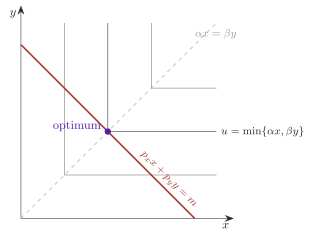
Perfect complements. The optimum is the kink where the budget line meets the ray .
The corner: the condition becomes an inequality
Now take perfect substitutes, . Usually the demand lies at a corner: all when , all when . There the marginal rate of substitution does not equal the price ratio; an inequality holds instead.
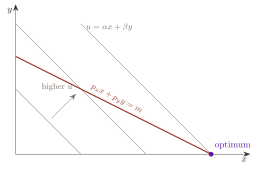
Perfect substitutes. The case in which indifference lines are steeper than the budget line, so the consumer consumes at the corner.
Notice that linear utility is quasi-concave and differentiable, but interior solutions are still not guaranteed.
The wrong curvature: the equation finds a local minimum
Consider an example from the production side. A competitive firm with U-shaped marginal cost faces , which can have two solutions — one on the falling branch, one on the rising. The condition holds at both; the second-order condition picks the rising branch, and on the falling branch the same equation marks a local minimum of profit. And even that is not the end of the story — at a price below minimum average variable cost the firm shuts down at , so supply is the rising part of above , then a jump to zero.
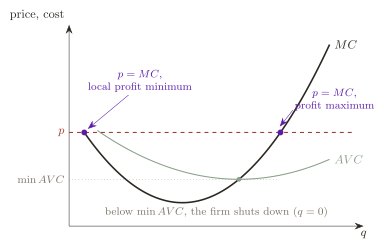
A U-shaped meets the price at two outputs. Only the rising-branch root is the profit maximum; below the firm shuts down.
The consumer-side twin is non-convex preferences, such as , whose indifference curves bend away from the origin. Tangency is then met at the worst bundle on the budget line; the best bundle(s) sit at the corners.
So I draw.